What Does an Egyptian Design Language Look Like in Contemporary Swimwear?
For House of Chaos, the answer is not to reproduce the past. It is to work with memory, proportion, symbol and material until the reference feels present rather than historical.
Egypt has an enormous visual vocabulary. It can also become an easy shortcut. A motif can be lifted, repeated and labelled Egyptian without the object around it carrying any real point of view. House of Chaos begins from the opposite position: reference should be reduced, questioned and translated before it becomes part of a garment.
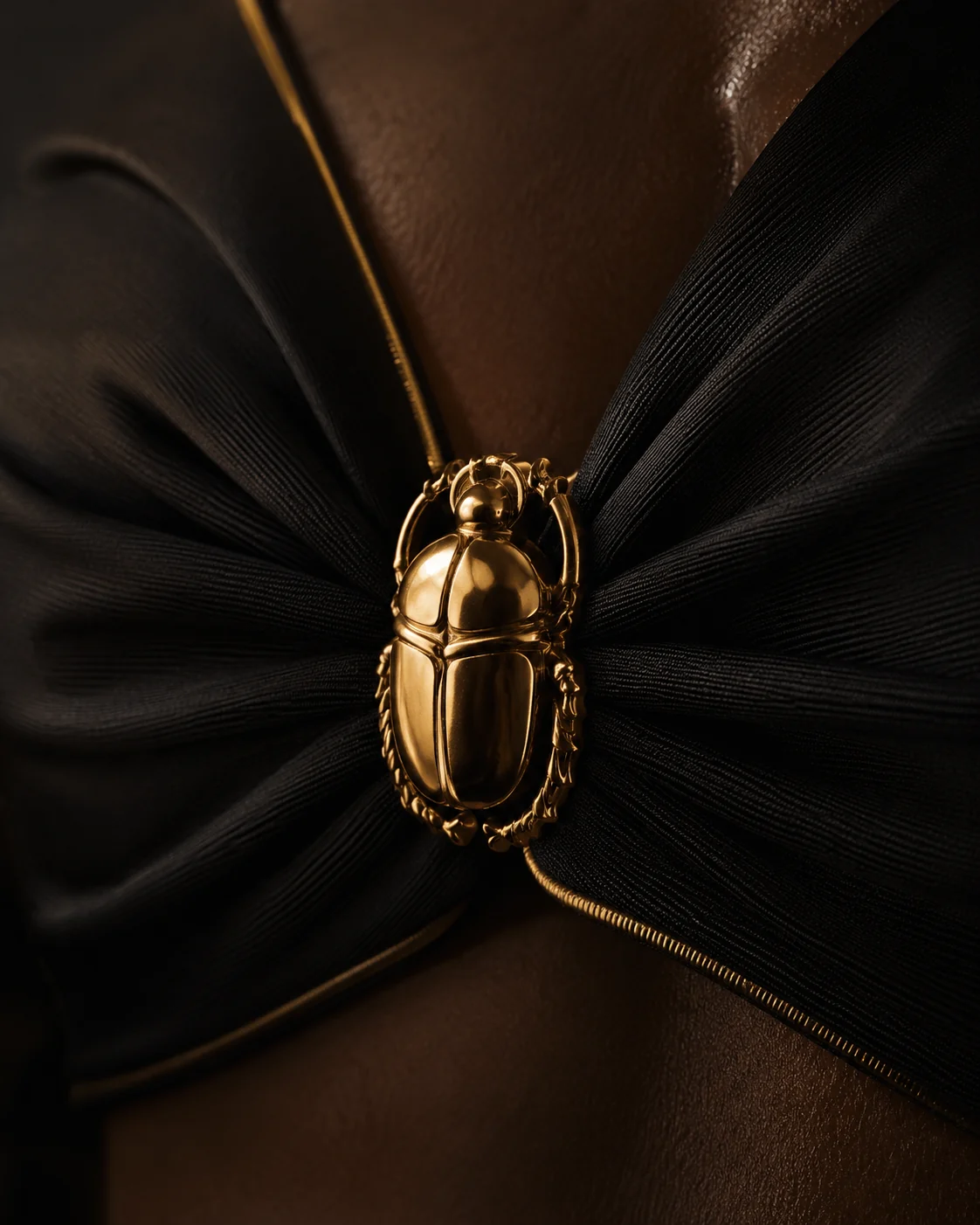
The early collection language therefore starts with a limited set of signals. The scarab is one. Onyx, ivory and gold are others. Strong line, negative space, metal against fabric and a tension between protection and exposure are recurring ideas. None of these elements is intended to turn swimwear into costume. They are design inputs rather than decoration applied at the end.
The scarab as a mark, not a theme.
The scarab appears in the House of Chaos world because it can hold several ideas at once: form, protection, transformation and repetition. In practice, that does not mean covering a collection in beetle imagery. It means asking what happens when a compact symbolic form becomes hardware, fastening, interruption or weight.
The difference matters. When a historical reference becomes a functional or structural detail, it participates in the garment. It can influence balance, placement and how the eye moves across the body. That is more interesting to House of Chaos than literal illustration.
Ancient memory. Contemporary restraint.
The collection is being built around contrast: dark against light, softness against metal, exposure against coverage, and a recognisable reference placed inside an otherwise modern silhouette. This is why the early visual palette is intentionally narrow. Restraint allows material and proportion to carry more of the identity.
That approach also connects swimwear to resortwear. The intention is not to create isolated beach pieces but a wardrobe that can move through the full rhythm of a summer day: water, shade, lunch, movement, evening. A consistent design language should survive those changes in context.
A point of view revealed slowly.
Founder and designer Injie Ashraf is revealing House of Chaos as a sequence rather than publishing the complete collection at once. The reason is partly creative: the world should become legible through its details before every garment is visible. Hardware, color, silhouette and story each establish a piece of the system.
It is also a useful discipline. A brand built around cultural reference has to be specific about what it means. Slow reveal creates room to explain why a mark exists, why a material is repeated and how a reference is being transformed rather than simply borrowed.
The collection stays private until it is ready.
House of Chaos is building toward its debut swim and resortwear collection for Summer 2027. Until then, the public site functions as a controlled preview: enough to understand the design direction, not enough to collapse the launch into a catalogue before the work is complete.